·by Lars Miller(Founder & Lead Editor)··4 min read·
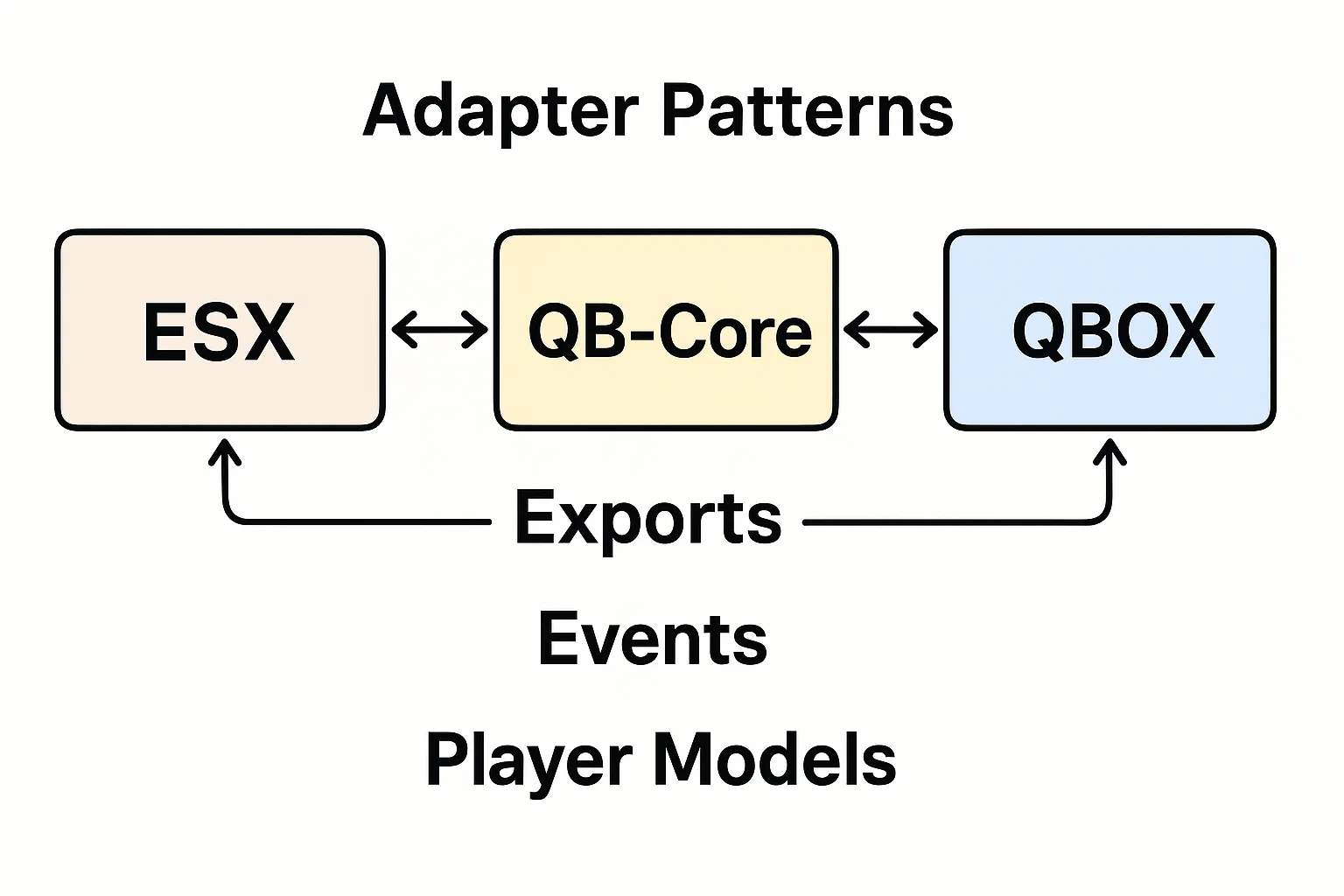
This is a FiveM Framework Adapter for scripters. Deliver a single resource that runs on ESX, QBCore, and QBOX by isolating framework-specific calls behind a lean adapter.
This is a FiveM Framework Adapter - for scripters. Ship one resource that runs on ESX, QBCore, and QBOX by isolating framework‑specific calls behind a thin adapter. Drop the shared/fw.lua and per‑framework adapters below into any resource, call the stable interface contract (FW.Player, FW.Job, FW.Money, FW.Inv, FW.Events), and keep business logic framework‑agnostic. A small test matrix with stubs catches mismatches before you deploy.
Why an Adapter?
Framework differences cluster around the same seams:
fxmanifest.lua (load adapters first, then fw.lua so detection can bind):
fx_version 'cerulean'
game 'gta5'
lua54 'yes'

shared_scripts {
  'shared/adapters/*.lua',
  'shared/fw.lua'
}

client_scripts {
  'client/*.lua'
}

server_scripts {
  '@oxmysql/lib/MySQL.lua', -- optional: if you use SQL
  'server/*.lua'
}
Turn framework research into a launch-ready script stack
Use this guide to narrow the framework decision, then move into the core commercial hubs for verified scripts, curated bundles, and a faster server launch path.
Framework hub
Move into the QBCore landing page to compare verified scripts, framework fit, and install-ready products built for modern FiveM servers.
Open QBCore hub
Framework hub
Use the ESX landing page to compare framework-specific resources, launch guidance, and premium products that fit ESX-first servers.
Open ESX hub
Premium catalog
Move from research into the main shop to compare real products, framework labels, screenshots, and production-ready quality signals.
Open premium shop
Premium Scripts You Might Like
Free Scripts You Might Like
Related Articles
This is a code‑first, no‑fluff easy converting FiveM scripts guide that shows you exactly how to Convert FiveM Scripts between ESX, QBCore, QBOX...
Compare QBox vs QBCore in 2026, check script compatibility, and follow a practical migration plan for ox_lib, ox_inventory, banking, jobs, and testing.
Introduction: Why frameworks matter Your framework decides how fast you build features, how stable your city runs, and how easily you can scale. In FiveM...
In your code (server or client):
-- use the stable interface everywhere
local src = source
local p = FW.Player.getBySrc(src)
local job = FW.Job.getName(p)
FW.Money.add(p, 'cash', 250, 'delivery-bonus')
FW.Inv.addItem(p, 'water', 1)
FW.Events.notify(src, 'Job bonus paid.', 'success')
The only symbol you depend on is FW. Everything else is internal to the adapters.
Interface Contract (stable surface)
Design goal: Small, explicit, documented. These are the functions you can rely on across frameworks.
Inventory note: servers vary (qb-inventory, ox_inventory, qs‑inventory, etc.). The default implementation uses framework inventory when available and falls back to ox_inventory if detected.
onPlayerLoaded(handler(src)) (best‑effort, with fallback via playerJoining)
Drop‑in Adapters (copy/paste)
These are pragmatic defaults. If your fork differs (especially for QBOX), adjust the few marked comments.
shared/fw.lua
-- framework bridge bootstrap
FW = FW or {}

local function started(name)
  local st = GetResourceState(name)
  return st == 'started' or st == 'starting'
end

local which
if started('qbx_core') then which = 'qbox'
elseif started('qb-core') then which = 'qbcore'
elseif started('es_extended') then which = 'esx' end

if which == 'qbcore' then
  FW = Adapters.qb()
elseif which == 'qbox' then
  FW = Adapters.qbox()
elseif which == 'esx' then
  FW = Adapters.esx()
else
  error(' No supported framework found (es_extended / qb-core / qbx_core).')
end

-- tiny helpers common to all adapters
function FW.meta.has(res)
  return started(res)
end
shared/adapters/esx.lua
Adapters = Adapters or {}

Adapters.esx = function()
  local ESX = exports['es_extended']:getSharedObject()

  local M = {
    meta = { name = function() return 'esx' end },
    Player = {}, Job = {}, Money = {}, Inv = {}, Events = {}
  }

  -- Player
  function M.Player.getBySrc(src) return ESX.GetPlayerFromId(src) end
  function M.Player.getStateId(p) return p.identifier end
  function M.Player.getServerId(p) return p.source end
  function M.Player.getName(p) return p.getName and p.getName() or GetPlayerName(p.source) end

  -- Job
  function M.Job.getName(p) return (p.getJob and p.getJob().name) or (p.job and p.job.name) end
  function M.Job.getGrade(p)
    local j = p.getJob and p.getJob() or p.job
    return j and (j.grade or (j.grade and j.grade.grade))
  end
  function M.Job.onChange(handler)
    -- ESX fires when job changes (commonly 'esx:setJob')
    RegisterNetEvent('esx:setJob', function(job)
      local src = source
      handler(src, nil, job and job.name)
    end)
  end

  -- Money
  local function norm(account) return account == 'cash' and 'money' or account end
  function M.Money.get(p, account)
    account = norm(account)
    if account == 'money' then return p.getMoney() end
    local acc = p.getAccount and p.getAccount(account)
    return acc and acc.money or 0
  end
  function M.Money.add(p, account, amount)
    account = norm(account)
    if account == 'money' then p.addMoney(amount) else p.addAccountMoney(account, amount) end
  end
  function M.Money.remove(p, account, amount)
    account = norm(account)
    if account == 'money' then p.removeMoney(amount) else p.removeAccountMoney(account, amount) end
  end

  -- Inventory (ESX native, with ox fallback)
  local hasOX = GetResourceState('ox_inventory') == 'started'
  if hasOX then
    function M.Inv.addItem(p, name, count, meta) return exports.ox_inventory:AddItem(p.source, name, count, meta) end
    function M.Inv.removeItem(p, name, count, meta) return exports.ox_inventory:RemoveItem(p.source, name, count, meta) end
  else
    function M.Inv.addItem(p, name, count) p.addInventoryItem(name, count); return true end
    function M.Inv.removeItem(p, name, count) p.removeInventoryItem(name, count); return true end
  end

  -- Events
  function M.Events.notify(target, msg, kind)
    kind = kind or 'info'
    -- Implement your UI notify event here. Example placeholder:
    TriggerClientEvent('fw:notify', target, msg, kind)
  end
  function M.Events.onPlayerLoaded(handler)
    RegisterNetEvent('esx:playerLoaded', function(_)
      handler(source)
    end)
  end

  return M
end
shared/adapters/qb.lua (QBCore)
Adapters = Adapters or {}

Adapters.qb = function()
  local QBCore = exports['qb-core']:GetCoreObject()

  local M = {
    meta = { name = function() return 'qbcore' end },
    Player = {}, Job = {}, Money = {}, Inv = {}, Events = {}
  }

  -- Player
  function M.Player.getBySrc(src) return QBCore.Functions.GetPlayer(src) end
  function M.Player.getStateId(p) return p.PlayerData.citizenid end
  function M.Player.getServerId(p) return p.PlayerData.source end
  function M.Player.getName(p)
    local pd = p.PlayerData
    return (pd.charinfo and (pd.charinfo.firstname .. ' ' .. pd.charinfo.lastname)) or GetPlayerName(pd.source)
  end

  -- Job
  function M.Job.getName(p) return p.PlayerData.job.name end
  function M.Job.getGrade(p)
    local g = p.PlayerData.job.grade
    return type(g) == 'table' and (g.level or g.grade) or g
  end
  function M.Job.onChange(handler)
    -- QBCore client event relays job update; mirror serverside via simple relay if needed.
    RegisterNetEvent('QBCore:Server:OnJobUpdate', function(job)
      handler(source, nil, job and job.name)
    end)
  end

  -- Money
  function M.Money.get(p, account) return p.PlayerData.money or 0 end
  function M.Money.add(p, account, amount, reason) p.Functions.AddMoney(account, amount, reason or 'fw') end
  function M.Money.remove(p, account, amount, reason) p.Functions.RemoveMoney(account, amount, reason or 'fw') end

  -- Inventory (qb-inventory or ox)
  local hasOX = GetResourceState('ox_inventory') == 'started'
  if hasOX then
    function M.Inv.addItem(p, name, count, meta) return exports.ox_inventory:AddItem(p.PlayerData.source, name, count, meta) end
    function M.Inv.removeItem(p, name, count, meta) return exports.ox_inventory:RemoveItem(p.PlayerData.source, name, count, meta) end
  else
    function M.Inv.addItem(p, name, count, meta) return p.Functions.AddItem(name, count, false, meta) end
    function M.Inv.removeItem(p, name, count) return p.Functions.RemoveItem(name, count) end
  end

  -- Events
  function M.Events.notify(target, msg, kind)
    TriggerClientEvent('fw:notify', target, msg, kind or 'info')
  end
  function M.Events.onPlayerLoaded(handler)
    RegisterNetEvent('QBCore:Server:PlayerLoaded', function()
      handler(source)
    end)
  end

  return M
end
shared/adapters/qbox.lua (QBOX / qbx_core)
Adapters = Adapters or {}

Adapters.qbox = function()
  -- QBOX typically exposes functions via exports only.
  -- If your fork also ships a GetCoreObject, swap accordingly.
  local QBX = exports['qbx_core']

  local M = {
    meta = { name = function() return 'qbox' end },
    Player = {}, Job = {}, Money = {}, Inv = {}, Events = {}
  }

  -- Player (QBOX uses Player with PlayerData similar to QBCore)
  function M.Player.getBySrc(src) return QBX:GetPlayer(src) end -- adjust if your API differs
  function M.Player.getStateId(p) return p.PlayerData.citizenid end
  function M.Player.getServerId(p) return p.PlayerData.source end
  function M.Player.getName(p)
    local pd = p.PlayerData
    return (pd.charinfo and (pd.charinfo.firstname .. ' ' .. pd.charinfo.lastname)) or GetPlayerName(pd.source)
  end

  -- Job
  function M.Job.getName(p) return p.PlayerData.job.name end
  function M.Job.getGrade(p)
    local g = p.PlayerData.job.grade
    return type(g) == 'table' and (g.level or g.grade) or g
  end
  function M.Job.onChange(handler)
    -- Some QBOX builds forward QBCore job events; if not, wire your own when setting jobs.
    RegisterNetEvent('QBCore:Server:OnJobUpdate', function(job)
      handler(source, nil, job and job.name)
    end)
  end

  -- Money
  function M.Money.get(p, account) return p.PlayerData.money or 0 end
  function M.Money.add(p, account, amount, reason)
    if p.Functions and p.Functions.AddMoney then p.Functions.AddMoney(account, amount, reason or 'fw')
    else QBX:AddMoney(p.PlayerData.source, account, amount, reason or 'fw') end
  end
  function M.Money.remove(p, account, amount, reason)
    if p.Functions and p.Functions.RemoveMoney then p.Functions.RemoveMoney(account, amount, reason or 'fw')
    else QBX:RemoveMoney(p.PlayerData.source, account, amount, reason or 'fw') end
  end

  -- Inventory (ox preferred on many QBOX servers)
  local hasOX = GetResourceState('ox_inventory') == 'started'
  if hasOX then
    function M.Inv.addItem(p, name, count, meta) return exports.ox_inventory:AddItem(p.PlayerData.source, name, count, meta) end
    function M.Inv.removeItem(p, name, count, meta) return exports.ox_inventory:RemoveItem(p.PlayerData.source, name, count, meta) end
  else
    -- fall back to qb-style if present
    if p and p.Functions and p.Functions.AddItem then
      function M.Inv.addItem(p, name, count, meta) return p.Functions.AddItem(name, count, false, meta) end
      function M.Inv.removeItem(p, name, count) return p.Functions.RemoveItem(name, count) end
    else
      function M.Inv.addItem() return false end
      function M.Inv.removeItem() return false end
    end
  end

  -- Events
  function M.Events.notify(target, msg, kind)
    TriggerClientEvent('fw:notify', target, msg, kind or 'info')
  end
  function M.Events.onPlayerLoaded(handler)
    -- Some QBOX builds reuse QBCore load events; if yours differs, relay from your login logic.
    RegisterNetEvent('QBCore:Server:PlayerLoaded', function()
      handler(source)
    end)
  end

  return M
end
Usage Examples
1) Paying a job bonus
RegisterNetEvent('myres:payBonus', function()
  local src = source
  local p = FW.Player.getBySrc(src)
  if not p then return end

  if FW.Job.getName(p) == 'delivery' then
    FW.Money.add(p, 'cash', 250, 'delivery-bonus')
    FW.Events.notify(src, 'Bonus paid (+$250).', 'success')
  else
    FW.Events.notify(src, 'You are not on duty as Delivery.', 'error')
  end
end)
2) Inventory grant with ox fallback already handled
local function giveStarter(src)
  local p = FW.Player.getBySrc(src)
  if p then FW.Inv.addItem(p, 'water', 2) end
end
FW.Events.onPlayerLoaded(giveStarter)
-- Example: populate your neutral key from ESX users
UPDATE my_table t
JOIN users u ON u.identifier = t.identifier
SET t.state_id = u.identifier
WHERE t.state_id IS NULL;

-- Example: migrate to QB/QBOX where you have a mapping table esx_identifier→citizenid
UPDATE my_table t
JOIN id_map m ON m.esx_identifier = t.state_id
SET t.state_id = m.citizenid
WHERE m.citizenid IS NOT NULL;
Keep the crosswalk (id_map) only during the transition; future writes should always use state_id.
Testing Matrix & CI: Validate a Script Across Frameworks
You don’t need to boot a full CFX server in CI to catch most adapter issues. Stub exports and run unit tests for the contract surface.
1) Minimal test (Busted)
tests/fw_spec.lua
local function makeStub(framework)
  _G.Adapters = {}
  if framework == 'esx' then
    _G.exports = { ['es_extended'] = { getSharedObject = function()
      return {
        GetPlayerFromId = function(src)
          return {source = src, identifier = 'license:abc', getMoney = function() return 100 end,
                  addMoney = function() end, removeMoney = function() end,
                  getJob = function() return {name='mechanic', grade=2} end,
                  addAccountMoney=function() end, removeAccountMoney=function() end,
                  addInventoryItem=function() end, removeInventoryItem=function() end,
                  getName=function() return 'Alex ESX' end }
        end
      }
    end } }
    _G.GetResourceState = function(n) return n=='es_extended' and 'started' or 'missing' end
    dofile('shared/adapters/esx.lua')
  elseif framework == 'qbcore' then
    _G.exports = { ['qb-core'] = { GetCoreObject = function()
      return { Functions = { GetPlayer=function(src)
        return { PlayerData={source=src,citizenid='CITZ123',job={name='mechanic',grade=2},
                              money={cash=100,bank=500},charinfo={firstname='Alex',lastname='QB'}},
                 Functions={AddMoney=function() end, RemoveMoney=function() end, AddItem=function() return true end, RemoveItem=function() return true end} }
      end } }
    end } }
    _G.GetResourceState = function(n) return n=='qb-core' and 'started' or 'missing' end
    dofile('shared/adapters/qb.lua')
  elseif framework == 'qbox' then
    _G.exports = { ['qbx_core'] = setmetatable({}, { __index = function()
      return function(name) end
    end }) }
    _G.GetResourceState = function(n) return n=='qbx_core' and 'started' or 'missing' end
    dofile('shared/adapters/qbox.lua')
  end
  dofile('shared/fw.lua')
end

describe('FW contract', function()
  it('resolves player and money (esx)', function()
    makeStub('esx')
    assert.are.equal('esx', FW.meta.name())
    local p = FW.Player.getBySrc(1)
    assert.are.equal('license:abc', FW.Player.getStateId(p))
    assert.are.equal(100, FW.Money.get(p, 'cash'))
  end)

  it('resolves player and money (qbcore)', function()
    makeStub('qbcore')
    assert.are.equal('qbcore', FW.meta.name())
    local p = FW.Player.getBySrc(2)
    assert.are.equal('CITZ123', FW.Player.getStateId(p))
    assert.are.equal(100, FW.Money.get(p, 'cash'))
  end)
end)