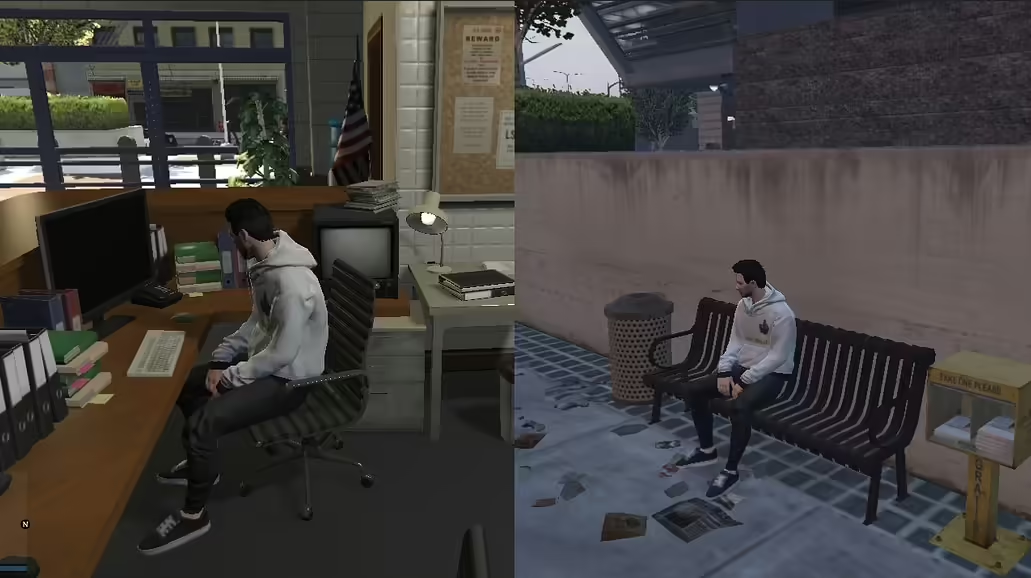
Sit Anywhere is a source-backed FiveMX recovery note with legacy WordPress facts, current routing, and safe FiveM install checks.
Share
Sit Anywhere FiveM Recovery and Setup Notes
Sit Anywhere is a recovered FiveMX WordPress free-mod record for a interaction script. The local migration files identify the old WordPress title as "Sit Anywhere", published on 2024-09-22, with WordPress categories free, scripts. Search Console recovery data marked the old path /free/scripts/sit-anywhere/ as a high-value missing free-mod URL with 364 recorded clicks, and the current FiveMX routing target is /free-mods/fivem/sit-anywhere. This MDX post preserves that context as an archive-backed setup guide. It does not claim that every historical mirror is still safe or current; server owners should use the current FiveMX page, inspect the package, and test the resource in staging before adding it to production.
Verified Recovery Record
Field
Local source-backed value
Recovered item
Sit Anywhere
Old WordPress title
Sit Anywhere
Old WordPress date
2024-09-22
Old WordPress categories
free, scripts
Legacy URL path
/free/scripts/sit-anywhere/
Current FiveMX target
/free-mods/fivem/sit-anywhere
Historical source status
GitHub source link recorded
Source review posture
reviewable
The recorded source is reviewable before install, which makes it suitable for a normal staging workflow. The safest user-facing path is the internal FiveMX recovery target, because that route can be updated, reviewed, redirected, or retired without sending readers to stale ad-gated links.
What This Resource Is For
Use an interaction-script recovery item when it improves small everyday actions without adding heavy framework dependencies. Sit-anywhere style resources are useful for social roleplay, events, and interiors that need more ambient behavior.
For Sit Anywhere, the source-backed facts are intentionally narrow: it existed as a published FiveMX WordPress free-mod post, it belonged to the categories listed above, it had measurable search demand, and it now resolves through the current free-mod recovery route. That is enough to rebuild a useful recovery page, but it is not enough to invent detailed performance numbers, compatibility promises, or creator support terms. Treat the old listing as a starting point for evaluation, then verify the actual package you plan to run.
Turn framework research into a launch-ready script stack
Use this guide to narrow the framework decision, then move into the core commercial hubs for verified scripts, curated bundles, and a faster server launch path.
Framework hub
Move into the QBCore landing page to compare verified scripts, framework fit, and install-ready products built for modern FiveM servers.
Open QBCore hub
Framework hub
Use the ESX landing page to compare framework-specific resources, launch guidance, and premium products that fit ESX-first servers.
Open ESX hub
Premium catalog
Move from research into the main shop to compare real products, framework labels, screenshots, and production-ready quality signals.
Open premium shop
Free Scripts You Might Like
Related Articles
The best FiveM scripts in 2026 are an Advanced MDT police system, a 911 dispatch and CAD tool, a full banking economy script, a 15+ civilian job pack, a modern smartphone with an…
The definitive list of the best free FiveM mods available in 2026. From MLOs and scripts to EUP packs and vehicles, these are the must-have resources for your server.
The best FiveM mods in 2026 are an Emergency Vehicle Mega Pack with 50+ marked and unmarked units, a Real-World Vehicle Collection with custom handling, a Modern Police Department…
A good recovery workflow separates three questions. First, does the resource still match the server need that made the old page valuable? Second, is the current package inspectable, compatible, and free from obvious risk? Third, can your team roll it back cleanly if the install creates map conflicts, UI errors, framework errors, or client performance problems? If any answer is unclear, keep the resource out of production until the gap is closed.
Source-Safe Evaluation Checklist
Test common chair, bench, booth, couch, vehicle, and map-prop cases rather than one perfect demo location.
Check how the script exits animations during damage, cuffing, carry, revive, teleport, and resource restart events.
Verify keybinds and target interactions do not conflict with emote menus or interaction systems.
Watch client performance near dense prop clusters because interaction scans can become expensive.
Open the current FiveMX target instead of copying a historical shortener or mirror from old exports.
Keep the original package name and folder name documented so future staff know which recovered item is installed.
Scan archives before extraction, then inspect fxmanifest.lua, __resource.lua, server files, client files, and any bundled binaries.
Search the package for webhook URLs, obfuscated code, remote loaders, suspicious exports, and commands that grant money, items, weapons, or admin power.
Start the resource on a staging server with the same artifact, framework, inventory, voice, and database versions as production.
Watch server console, client F8 logs, and resmon while running the real roleplay actions the resource is supposed to support.
Write down the rollback steps before launch: resource removal, database rollback, cache cleanup, and any player-data cleanup.
Install Workflow For A Live FiveM Server
Download only from the current recovery page or a source you can inspect. Do not reuse an old ad-gated mirror just because it appeared in a WordPress export.
Create a staging branch or server profile and install the resource under a clear folder name such as resources/[recovered]/sit-anywhere.
Read the manifest before starting the server. Note dependencies, game build requirements, escrow state, shared scripts, and database setup instructions.
If SQL files are included, apply them to a copy of the database first. Confirm table names, indexes, and migration reversibility before touching production data.
Add the resource near related resources in server.cfg; keep it after framework dependencies and before scripts that call its exports.
Start the server and fix console errors before doing gameplay tests. A resource that starts with warnings may still break later under player load.
Test the exact feature path with two players when possible. Single-player checks miss permissions, synced state, voice, dispatch, inventory, and target-interaction issues.
Measure client and server performance before and after the install. Keep the resource disabled if idle cost, streaming memory, or network events rise without a clear reason.
Launch with a small staff-only or whitelisted test first. Collect reports for at least one restart cycle before marking the recovery complete.
Compatibility Notes
The old WordPress category is useful for routing, but it is not a compatibility guarantee. A resource tagged as scripts may still depend on QBCore, ESX, QBox, ox_lib, oxmysql, qb-target, ox_target, pma-voice, or a specific inventory. A resource tagged as graphics-mods, mlo, cars, or clothes may still affect streaming budgets, file replacement order, or client assets. Read the package before assuming it is standalone.
For Sit Anywhere, start by checking the folder structure. If it includes only streamed assets and a manifest, the review is mostly asset size, collision, texture, and map overlap. If it includes server scripts, exports, events, commands, SQL, or webhooks, treat it like application code. Script resources need permission review, event validation, database review, and exploit testing. UI resources need browser-console checks inside NUI plus resolution testing on common player displays.
Interaction resources need extra checks around edge cases that players trigger constantly. Test seating while cuffed, dead, carrying another player, inside interiors, near vehicles, and during resource restart. If your server already has an emote menu, target system, or chair script, decide which resource owns the interaction before launch.
Production Rollout Criteria
A recovered FiveM resource is production-ready only when it meets these conditions:
The source package is identifiable and current enough to audit.
The server owner understands what files the resource replaces or adds.
The resource starts without console errors on the same artifact version as production.
The real gameplay path works after a full server restart.
Staff can remove or disable the resource without breaking unrelated systems.
The resource does not introduce unreviewed admin commands, money flows, item grants, or remote loaders.
Players can understand the change without needing a support ticket for normal use.
Do not skip those criteria for an old high-traffic page. Search demand proves that players looked for the resource; it does not prove the package is safe today.
When To Use It
Use Sit Anywhere when it solves a concrete server problem and you have time to test it properly. It is a better fit for an owner who can stage the install, inspect the files, and document dependencies than for a server that adds free resources directly to production. Skip it when your server already uses an emote or target system that owns seating interactions cleanly.
If the current package no longer matches the old WordPress listing, keep the blog post as an archive note and route users to a safer category hub. That is still better than pretending an old mirror is current.
Related FiveMX Resources
For adjacent recovery and install work, these FiveMX guides are the most useful next reads:
No recovered free-mod page should be treated as safe just because it existed in WordPress. Use the current FiveMX target, inspect the package, scan archives, review source files, and test the resource on staging before production.
Why does this page avoid old shortener links?
The local recovery data contains historical link exports, but old shorteners and file mirrors can drift, expire, or point to packages that no longer match the listing. This page routes readers to the current FiveMX target and focuses on verification steps.
What should I test first after installation?
Start with console errors, client F8 errors, resource startup order, and the primary gameplay path. Then test restart behavior, permissions, rollback, and performance under realistic player conditions.
Can I use this on QBCore, ESX, or QBox?
The WordPress category alone does not prove framework support. Check the package manifest, readme, config files, SQL files, and exports. If framework support is unclear, treat it as unverified until staging tests prove otherwise.
What if the package differs from the old WordPress title?
Do not force the install. Keep the recovery note for search and archive context, then choose a current alternative from FiveMX or an inspectable upstream source. A clean replacement is safer than a guessed restoration.