
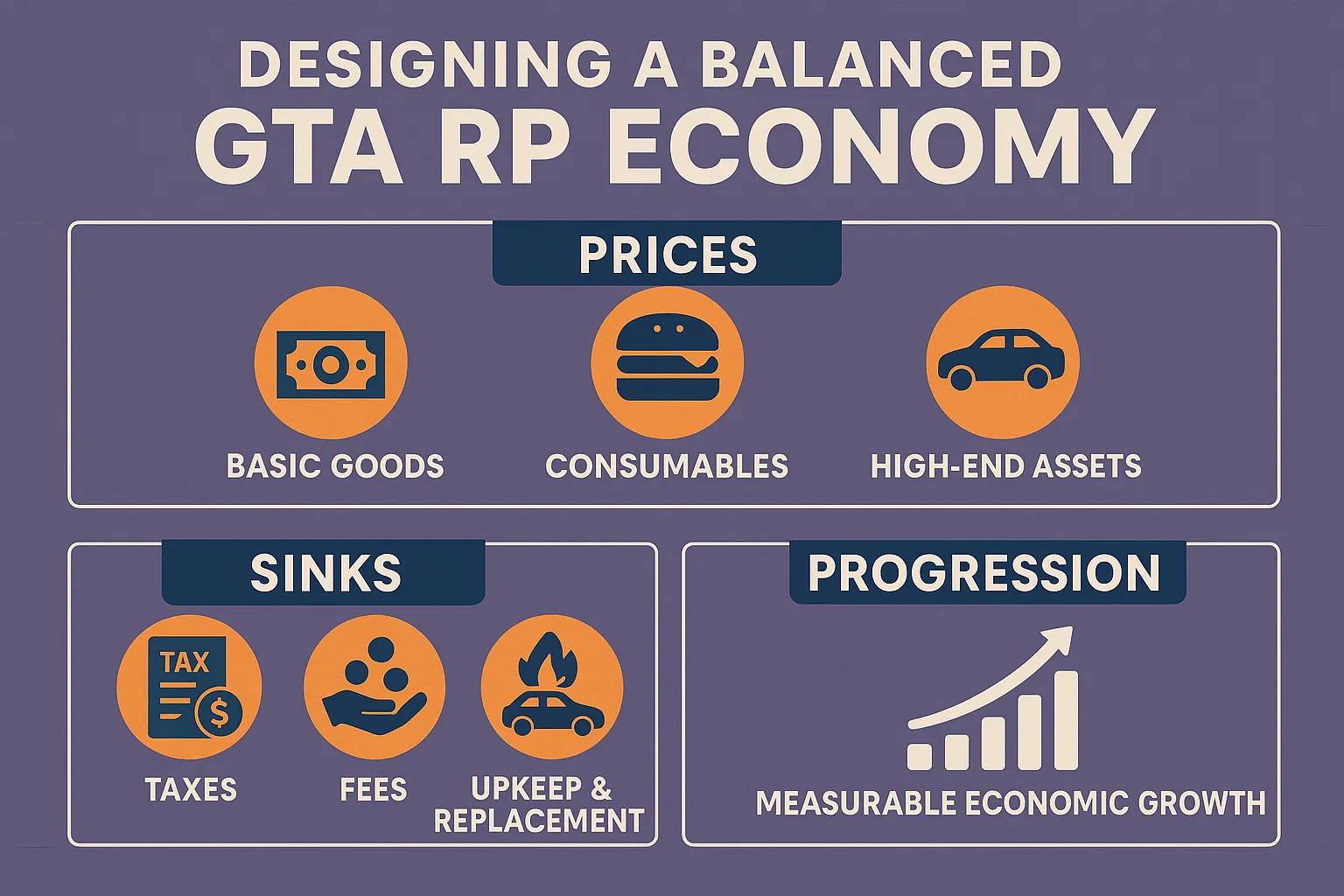
A complete, practical framework for FiveM servers (ESX & QBCore) with calculators, starter prices, and sample configs.
Who this is for: Server owners, economy designers, and devs who want a fair, grind‑free progression curve with healthy money sinks and stable prices.
Executive Summary
A good GTA RP economy makes money meaningful without turning progression into a chore. You need:
- Clear income routes (faucets) balanced by compelling, recurring sinks.
- A predictable early-game path (first car, starter house, toolkit) in X hours/days.
- Mid/late-game goals (businesses, prestige vehicles, cosmetics) that preserve challenge.
- Instrumentation (metrics, dashboards) and guardrails (taxes, dynamic pricing) to keep inflation in check.
This guide gives you:
- A balancing workbook (XLSX + CSV) with price & sink calculators.
- Starter price tables and progression milestones.
- Sample config packs for ESX and QBCore (shops, vehicles, taxes, paychecks).
- A rollout checklist and live‑ops playbook.
👉 Also see Economy System Scripts for ready‑to‑use modules.
Core Principles
- Faucet–Sink Equilibrium: Daily inflows ≈ daily outflows for the median active player.
- Time‑Fairness: Payouts scale with time-on-task × difficulty × risk, not with meta exploits.
- Predictable Onboarding: First meaningful milestone (starter car + toolkit) reachable in 6–10 hours of varied play.
- Recurring Costs > Punitive Taxes: Regular, opt‑in costs (maintenance, insurance, cosmetics) feel less punishing than flat income taxes.
- Elastic Controls: Use dynamic fees/markups and seasonal rebasing to nudge—not nuke—the economy.
Economy Model (What to Track)
Faucets (money in): legal jobs, deliveries, resource gathering, player trading margins, criminal payouts, government salaries, events.
Sinks (money out): vehicle purchases/licensing, maintenance & fuel, fines & citations, crafting & repairs, housing & storage, cosmetics, business fees, lotteries/raffles.
Key KPIs:
- Median Net Flow / day = Faucets − Sinks (target ≈ 0 for median; slightly positive for new players, slightly negative for late-game).
- Time to First Car/House/Business (p50, p80).
- Gini (wealth inequality) and % wealth top decile.
- Velocity of Money (trades per day per $).
Step‑by‑Step Balancing Process
- Define Milestones & Targets
- First car: 35k–60k within 6–10 hrs.
- First house/storage: 120k–200k within 25–40 hrs.
- Business buy‑in: 400k–1.2M within 80–150 hrs.
- Set Baseline Prices (Tiered)
- Tier 1 essentials (food/water/repair kits) affordable; Tier 3–4 gear aspirational; Tier 5–6 prestige.
- Design Payouts via Formula
Payout = base_per_min × minutes × difficulty × risk × team × scarcity.
- Introduce Recurring Sinks
- Insurance, maintenance, storage fees, business overhead, vanity sinks.
- Install Guardrails
- Luxury taxes, import duties, dynamic shop markups, progressive fines.
- Instrument & Iterate
- Log faucets/sinks per source, track net flows by cohort (new vs veteran), adjust weekly.
Starter Price Table (Suggested Ranges)
| Category | Tier | Examples | Price (Suggested) |
|---|---|---|---|
| Consumables | 1 | Water, Sandwich | 15–35 |
| Tools | 1–2 | Repair Kit, Lockpick Basic | 750–1,500 |
| Entry Vehicles | 2 | Compact, Low‑end Sedan | 35,000–60,000 |
| Work Vehicles | 3 | Van, Pickup | 65,000–120,000 |
| Mid Cars | 3–4 | Sedan/Coupe | 120,000–250,000 |
| High‑End | 5 | Sports | 350,000–750,000 |
| Exotic/Prestige | 6 | Super | 1.2M–3.0M |
| Housing (starter) | 2–3 | Motel/Small Apt | 120,000–200,000 |
| Housing (mid) | 4 | Apt/Small House | 350,000–700,000 |
| Business buy‑in | 4–6 | Shop/Club/Dealership | 400,000–1,200,000+ |
Use the workbook sheets
price_catalogandvehicle_cost_calcto tune these to your server.
Job Payout Design (Formula & Multipliers)
Base rate per minute (legal): 160–240.
Multipliers (suggested):
- Difficulty: 1.00 (easy), 1.25 (moderate), 1.50 (hard).
- Risk (criminal exposure): 1.00 (none), 1.35 (medium), 1.75 (high).
- Team: 1.00 (solo), 1.10 (duo), 1.20 (squad ≥3).
- Scarcity (server‑wide event): 1.00–1.40.
Example: 12‑min armored delivery, moderate difficulty, medium risk, duo.Payout ≈ 200 × 12 × 1.25 × 1.35 × 1.10 ≈ 4,455
Use the workbook’s job_payout_calc to standardize across all activities.
Recurring Sinks That Don’t Feel Punitive
- Insurance (per real‑day): 0.15–0.35% of vehicle value (cap exotics to avoid runaway costs).
- Maintenance: wear‑based (distance/time), 400–1,800 per service.
- Storage & Housing Fees: 600–2,400 per day; scale with slots.
- Licensing & Renewals: driver/firearm/fishing licenses with 7–14 day renewal periods.
- Cosmetics & Vanity: plates, liveries, emotes, clubs—bottomless sinks with zero power creep.
- Business Overhead: utilities, staff wages, %‐of‐sales fee.
Vehicle & Property Pricing Model
Vehicle Total = MSRP × (1 + import_tax) + dealer_fee + license_fee
import_tax: 5–15% (elastic, can auto‑adjust with inflation index)dealer_fee: 2–6%license_fee: flat 500–2,500 by class
Ongoing: insurance per day, maintenance per km/time, fuel price elasticity (1.5–3.5 per litre baseline).
Property: base price + property tax (0.05–0.20% per real‑day) + utilities (tiered by storage).
The workbook sheets vehicle_cost_calc and property_tax_calc implement these.
Dynamic Controls (Inflation Guardrails)
- Luxury Tax: +5–12% on Tier 5–6 vehicles when inflation index > 1.05.
- Import Duty Ladder: +2% per 10% supply‑demand imbalance.
- Dynamic Shop Markup: 0.9–1.3× based on stock & sales velocity.
- Progressive Fines: scale with wealth bracket, not flat values.
Configure these via scheduled scripts that read rolling 7‑day metrics and update server convars.
Progression Curves (Practical Targets)
| Milestone | Time Target | Notes |
|---|---|---|
| First 50k | 6–10 hrs | mix legal jobs & deliveries; small fines won’t block |
| First Car | 6–10 hrs | cash + trade‑in options; financing optional |
| First House/Storage | 25–40 hrs | recurring utilities motivate play |
| Business Buy‑In | 80–150 hrs | requires multi‑source income, team play |
Anti‑Exploit & Stability
- Cap high‑variance payouts (heists) with cooldowns & anti‑farm checks.
- Price Floors on raw resources; Price Ceilings on essentials during shortages.
- Server‑side validation for sales, distance, time‑on‑task, and duty status.
- Audit Trail: log each faucet/sink with
player_id,source,amount,ctx.
Telemetry You Should Log
- Per‑player: faucets, sinks, net flow/day, wealth, vehicle/property count.
- Per‑source: total payout/sales, average per event, participants.
- Price index: weekly basket (Tier 1–4) = base 100.
- Inflation triggers: import tax, insurance index, markup index.
Build a lightweight dashboard that reads your DB and plots:
- Median Net Flow/day (N7) by cohort.
- Basket Price Index vs time.
- Top 10 Faucets/Sinks by total.
Rollout Plan (2 Weeks)
Week 1 – Staging
- Import starter prices & sinks from the workbook.
- Patch job scripts to use formula‑based payouts.
- Enable dynamic markups (read‑only; dry‑run logs).
- Run a 48‑hr closed test; capture KPIs.
Week 2 – Live
- Launch with conservative payouts, strong recurring sinks.
- Enable dynamic markups in “bounded mode” (±10%).
- Daily review: faucets/sinks, top exploits; weekly rebalance.
Sample Configs (ESX & QBCore)
The downloadable packs include example configs for shops, vehicles, paychecks, and taxes.
Adapt paths/structure to your fork (comments inline). Highlights:
ESX (examples)
-- esx_shops.sample.lua
Config.Shops = {
 ["24/7"] = {
 Items = {
 { name = "water", price = 25 },
 { name = "sandwich", price = 30 },
 { name = "repairkit", price = 900 },
 }
 }
}
-- esx_vehicleshop.sample.lua
Config.Vehicles = {
 { model = "blista", label = "Blista", price = 42000, class = "compact" },
 { model = "asea", label = "Asea", price = 56000, class = "sedan" },
}
Config.Fees = { importTax = 0.08, dealerFee = 0.03, licenseFee = 1000 }
-- esx_paycheck.sample.lua
-- Example bands (society salaries)
Config.Paychecks = {
 police = { recruit = 650, officer = 900, sergeant = 1200 },
 ambulance = { intern = 600, ems = 850, doctor = 1100 }
}
-- esx_taxes.sample.lua
Config.Taxes = {
 propertyDailyRate = 0.0012, -- 0.12% per real‑day
 insuranceDailyRateByClass = { compact = 0.0018, sedan = 0.0022, sports = 0.0030, super = 0.0035 }
}
QBCore (examples)
-- qb-shops.sample.lua
Config.Products = {
 ["247supermarket"] = {
 { name = "water", price = 25, amount = 100 },
 { name = "sandwich", price = 30, amount = 100 },
 { name = "repairkit", price = 900, amount = 20 },
 }
}
-- qb-vehicleshop.sample.lua
Config.Vehicles = {
 { model = "blista", name = "Blista", price = 42000, category = "compacts" },
 { model = "asea", name = "Asea", price = 56000, category = "sedans" },
}
Config.Fees = { importTax = 0.08, dealerFee = 0.03, licenseFee = 1000 }
-- qbcore-items-prices.sample.lua
QBShared.Items["water"].price = 25
QBShared.Items["sandwich"].price = 30
QBShared.Items["repairkit"].price = 900
-- qb-taxes.sample.lua
Config.Taxes = {
 propertyDailyRate = 0.0012,
 insuranceDailyRateByClass = { compacts = 0.0018, sedans = 0.0022, sports = 0.0030, super = 0.0035 }
}
These are examples: align with your resource versions and naming.
Workbook: What’s Inside
faucets– define all income sources; computes daily inflow using DAP and event frequency.sinks– recurring/one‑off outflows; computes daily outflow.price_catalog– tiers, base prices, and markups (legal vs black market).job_payout_calc– formula‑based payouts with multipliers.vehicle_cost_calc,property_tax_calc– one‑time + recurring cost models.dynamic_pricing– elasticity controls by stock & velocity.economy_overview– summary dashboard (net flow, milestones, guardrails).
Import this into Google Sheets or Excel; all formulas are included.
FAQ
Q: Should we tax income directly?
Prefer recurring optional sinks (insurance, upkeep) and elastic markups. Use income tax sparingly for top‑bracket players only.
Q: How do we avoid pay‑to‑win perceptions?
Make all performance‑impacting items attainable in a reasonable time; keep cosmetic sinks infinite.
Q: How often should we rebalance?
Minor nudges weekly, major changes seasonally (4–8 weeks), with clear patch notes.
Next Steps
- Download the workbook and config packs.
- Import starter prices, run a weekend test.
- Ship with conservative faucets, visible sinks, and dynamic guardrails.
- Iterate using your KPIs.
Downloads
Related reading: 👉 Economy System Scripts (modules for taxes, markups, business overhead, etc.)