







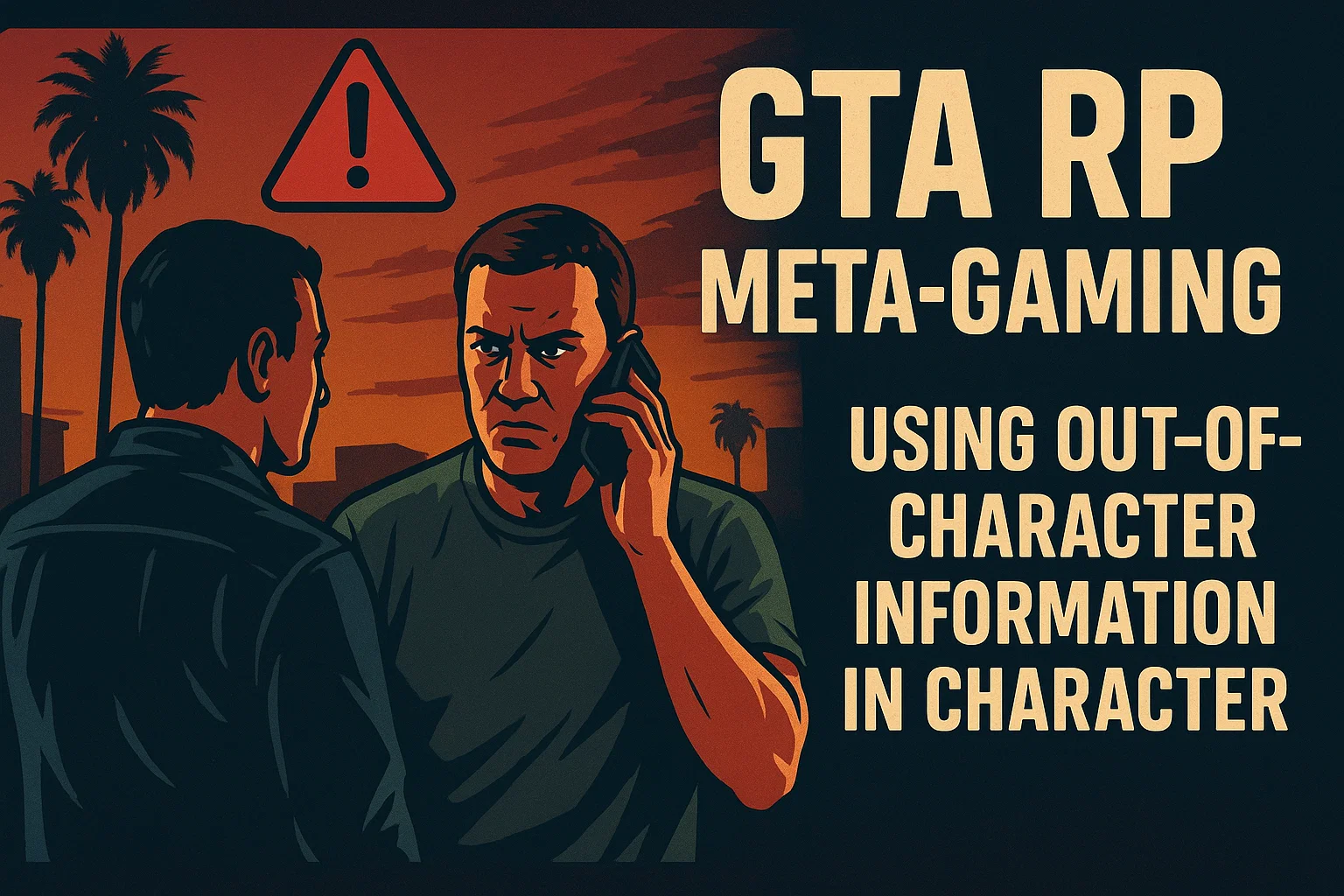
Metagaming in FiveM roleplay means using information learned outside the character’s experience to change an in-character decision. The key question is not where information exists, but whether the character could reasonably know it under that server’s published rules.
There is no universal FiveM punishment, command or enforcement tool for metagaming. Each community defines its own roleplay standard, evidence process and sanctions. Read the rules of the server you are playing on.
Clear examples of metagaming
- Watching a livestream to find a character’s current location and travelling there in game.
- Reading a Discord staff or faction channel and acting on the information through a character who was not told.
- Recognizing a masked character only from the player’s username, voice chat overlay or out-of-character history when the server’s rules do not allow it.
- Telling friends through an external call that your character is being robbed, then having their characters respond without an in-character message.
- Using a map, player list or admin interface that your current role is not permitted to use to locate another character.
What is not automatically metagaming
Information can move into character knowledge through a permitted in-character conversation, radio, dispatch system, witness report or persistent record. Some communities also allow limited recognition by voice or prior encounters. The deciding rule is the server’s documented boundary, not a definition copied from another community.
A coincidence is not proof by itself. Moderators should distinguish what a player knew, when they learned it and which in-character action allegedly changed.
Powergaming and stream sniping are related but different
Powergaming usually concerns forcing unrealistic outcomes or using mechanics in a way that denies reasonable roleplay. Stream sniping describes using a live broadcast to gain an advantage or interfere with the streamer. Stream sniping often produces metagaming, but a server may define and enforce the behaviours separately.
How players should handle outside information
- Do not act on the information through your character.
- Move the external stream or chat out of view while playing.
- Use only the server’s permitted in-character channel to learn or relay the fact.
- If the situation affects an active scene, ask staff through the designated out-of-character route without escalating in public chat.
- Report suspected abuse with timestamps and the minimum necessary evidence; do not publish another player’s personal information.
How server owners can write a usable rule
A rule should define the protected boundary and give examples relevant to the server’s actual systems:
Do not use information your current character did not obtain through an approved in-character source. This includes livestreams, external voice calls, out-of-character Discord channels and restricted staff or faction interfaces. If you receive outside information accidentally, do not act on it and contact staff when it affects an active scene.
Then document server-specific exceptions such as voice recognition, character memory after incapacitation, shared faction records and permitted dispatch tools. Avoid claiming that an automated detector can determine a player’s knowledge; logs and clips provide context, not intent by themselves.
Moderation should be evidence-based
Use a consistent process: identify the rule version, collect relevant timestamps, let the player respond and choose a proportionate outcome under the published policy. Do not invent universal ban durations or promise that a plugin prevents metagaming. Training, clear system design and predictable moderation reduce ambiguity better than a generic command list.