Use Coupon WELCOME to save 20%

$ USD
  • $ USD
  • € EUR
  • £ GBP
  • $ AUD
  • R$ BRL
  • CHF CHF
  • ¥ JPY
How to Migrate ESX → QBCore the Right Way

How to Migrate an ESX Server to QBCore

Direct answer: Migrating ESX to QBCore is a controlled rewrite and data migration, not a framework switch. Build a clean QBCore staging server, inventory every ESX dependency, define an explicit field-by-field data map, port resources against current APIs, rehearse rollback, and cut over only after referential and gameplay checks pass.

QBOX vs QBCORE

Qbox vs QBCore: Differences, Compatibility and Migration

Choose Qbox for a new server when you want its modern, OX-integrated stack and are prepared to follow its conventions. Keep QBCore when your stable server depends on QBCore-specific resources and a migration has no clear payoff. Qbox provides a compatibility bridge for most properly written QBCore scripts, but compatibility is not universal.

QBox Logo

Qbox Framework Guide: Install, QBCore Bridge and Migration

Qbox is a FiveM roleplay framework that began as a QBCore fork and now provides its own core APIs and resources. It keeps a compatibility bridge for many properly written QBCore resources, but direct database access, internal-file access and unsupported behavior are documented exceptions. Use the official Qbox txAdmin recipe for a new installation and audit every resource before a migration.

mysql async oxmysql

Migrate mysql-async Resources to oxmysql Safely

Move a resource from mysql-async to oxmysql by changing its driver setup and reviewing each query’s parameters, return value and error handling. A driver migration does not require rewriting your database schema, and it does not guarantee faster gameplay.

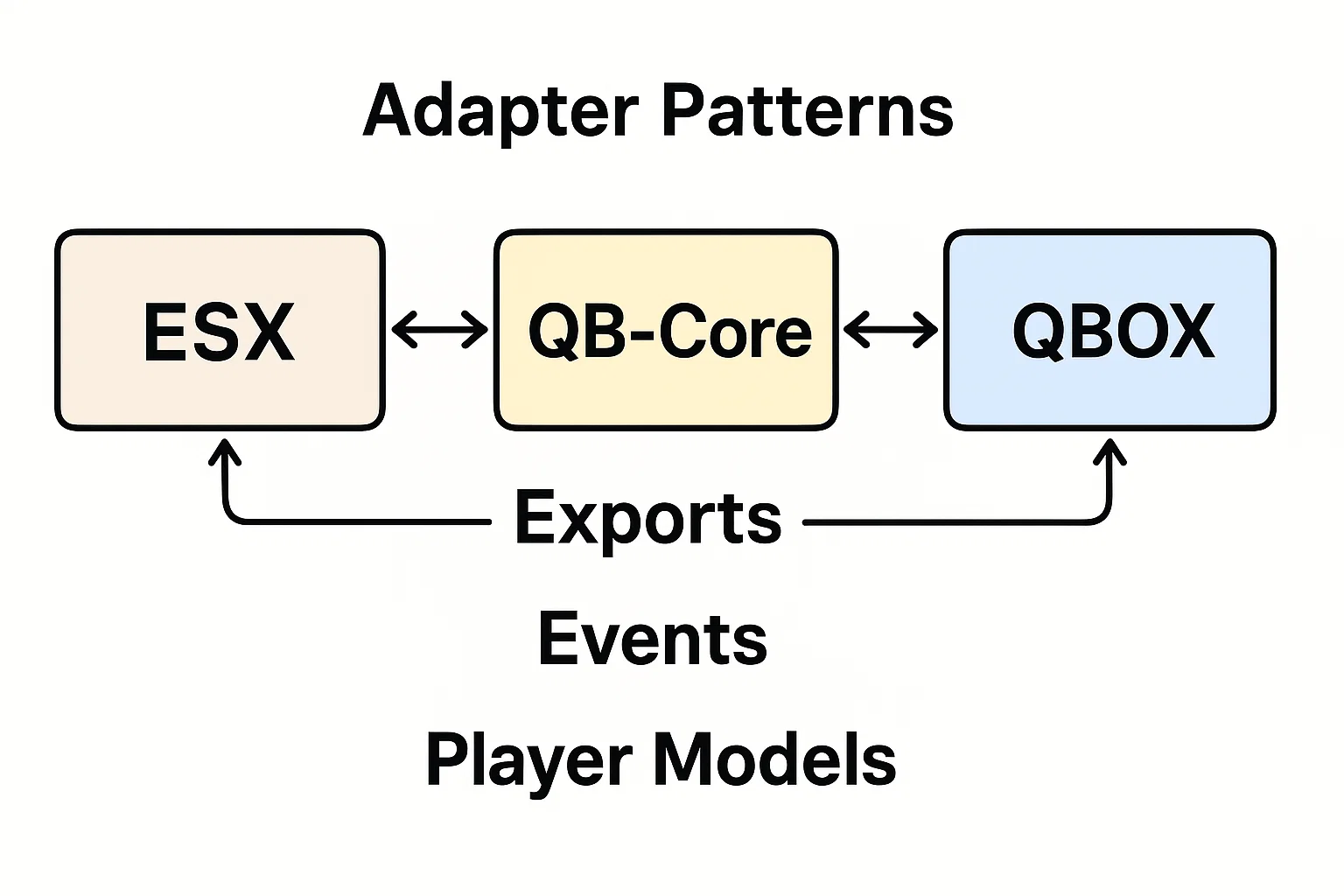
Adapter Patterns: ESX↔QBCore↔QBOX (Exports, Events &a…

Build a Small FiveM Framework Adapter

A framework adapter gives your resource a small interface while keeping ESX, QBCore and Qbox details in one place. Start with a read-only operation, verify it on each supported framework, and add money or inventory operations only when their failure behavior is defined.

Converting FiveM Scripts – ESX, QBCore, QBOX (Frame…

Convert FiveM Scripts Between ESX, QBCore and Qbox

Convert a FiveM resource by mapping its framework, inventory and database dependencies, then testing one gameplay flow at a time. Renaming ESX events to QBCore events is not a complete conversion. A server-wide character migration is a separate project.

FiveM Frameworks: QBCore vs. ESX

Simultaneous Use of ESX and QBCore: Why It’s Not Feasible

Direct answer: Do not run ESX and QBCore as two authoritative cores for the same players. Both can technically start as FiveM resources, but they model identity, jobs, money, inventory, callbacks and events differently. Without a purpose-built bridge and one declared source of truth, duplicated state becomes unsafe and hard to recover.

ESX Framework Guide: Official Install, Updates and Compatibility

ESX Framework Guide: Official Install, Updates and Compatibility

ESX Legacy is an open-source FiveM roleplay framework. For a new server, use the official ESX Legacy template in txAdmin or follow the complete official installation documentation. Installing only the es_extended folder is not a complete server setup because the supported stack includes database work, required resources and an ordered startup configuration.

QBCore Framework Guide: Architecture, Install and Compatibility

QBCore Framework Guide: Architecture, Install and Compatibility

QBCore is an open-source roleplay framework for FiveM. Its qb-core resource exposes shared player data, framework functions, commands and definitions that other QB resources can use. For a new server, use the official QBCore txAdmin recipe rather than treating the qb-core folder as a complete installation.

FiveM Frameworks: QBCore vs. ESX

FiveM Frameworks Compared: ESX, QBCore and Qbox

There is no official universal winner between ESX, QBCore and Qbox. Choose the framework whose current recipe, APIs and compatible resources match your required server features, existing data and team skills. If you already operate a stable framework-specific stack, staying in that ecosystem is usually the first option to evaluate because migration touches more than the core folder.