






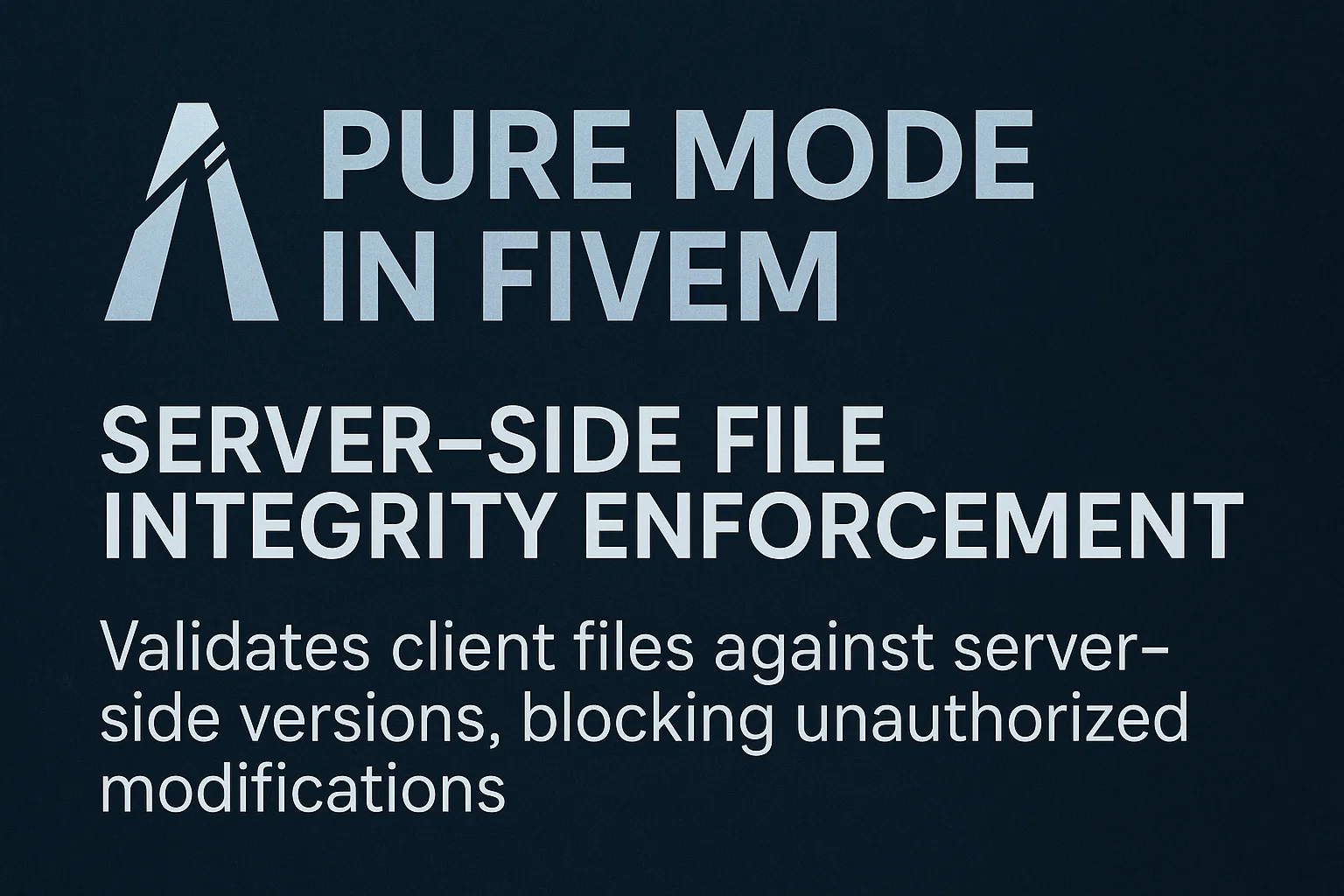
FiveM Pure Mode is a server setting that restricts modified client files. Dodaj sv_pureLevel 1 Lub sv_pureLevel 2 do server.cfg, restart FXServer, and test with the same graphics and audio modifications your players use. Level 1 allows audio files and known graphics mods; level 2 blocks all modified client files.
Verified against the official Cfx.re server-command reference on August 4, 2026.
FiveM Pure Mode levels compared
| Ustawienie | What Cfx.re says it blocks | Practical use |
|---|---|---|
| Pure Mode off | No Pure Mode restriction is applied. | Useful only when the server deliberately accepts client file modifications. |
sv_pureLevel 1 |
Blocks modified client files except audio files and known graphics mods. | A balanced starting point for many roleplay servers. |
sv_pureLevel 2 |
Blocks all modified client files. | Stricter events or servers that require a clean client-file baseline. |
Cfx.re currently documents two enforcement levels: 1 and 2. Do not rely on old file-extension allowlists from forum posts. The maintained documentation describes the policy by file category, and FiveM can change which known modifications it recognizes.
How to enable FiveM Pure Mode
- Back up the active
server.cfg. - Add one Pure Mode line to the configuration loaded at server startup:
sv_pureLevel 1Używać sv_pureLevel 2 only when you have tested the stricter policy with representative players.
- Restart FXServer so the configuration is reloaded.
- Join with a clean client, then repeat the test with a known graphics or audio modification.
- Record which client file is rejected and confirm that normal players can still connect.
sv_pureLevel 1 vs 2: which should you use?
Start with level 1 when your community uses legitimate audio or recognized graphics modifications and you want a safer rollout. Use level 2 when the server requires every client to use unmodified files and your test group has confirmed that the restriction does not block an expected accessibility or visual setup.
For example, an NVE or ReShade user may be able to join a level-1 server when FiveM recognizes the installed graphics modification, while level 2 is designed to block all modified client files. Test the exact current client setup rather than promising that a named mod will always be allowed.
How to fix a Pure Mode modified-files error
The official documentation distinguishes files installed in the FiveM folder from modified GTA V base-game files. FiveM-folder modifications are ignored when blocked. If a base-game file was modified, the player receives an error identifying the changed file.
- Save the exact filename shown in the error.
- Close FiveM and remove the relevant client modification.
- Restore or verify the original GTA V file through the player’s game launcher when a base-game file changed.
- Restart FiveM before reconnecting.
- If the error remains, test with a clean FiveM application-data folder before changing the server policy.
Do not tell players to delete unrelated folders or disable security software at random. The named file and a clean-client comparison are better evidence.
What Pure Mode does not do
Pure Mode is a client-file integrity control. It does not replace server-side permission checks, secure network events, staff review, logging, or a maintained anti-cheat strategy. A server should still validate sensitive actions on the server and follow the current Cfx.re event-security guidance.
- It does not prove that every script or event is secure.
- It does not repair vulnerable resources.
- It does not replace an allowlist, staff process, or evidence review.
- It can create support work when players use modified base-game files.
FiveM Pure Mode questions
Does Pure Mode block ReShade or NVE?
Level 1 allows known graphics mods, while level 2 blocks all modified client files. Recognition can change, so test the exact current mod and client build.
Is sv_pureLevel an anti-cheat?
It is one file-integrity control, not a complete anti-cheat. Keep server-side validation and security controls in place.
Should a roleplay server use level 1 or level 2?
Level 1 is the lower-risk starting point when players use accepted visual or audio mods. Level 2 is stricter and should be tested before a public rollout.
Why does Pure Mode name a GTA V file?
That normally means a base-game file differs from the expected version. Restore or verify that file through the game launcher, restart FiveM, and try again.
Official source and related guides
Check the maintained Cfx.re sv_pureLevel documentation before changing production. For adjacent checks, see the FiveM graphics-mod guide, NVE installation guide, oraz free FiveM anti-cheat options.