
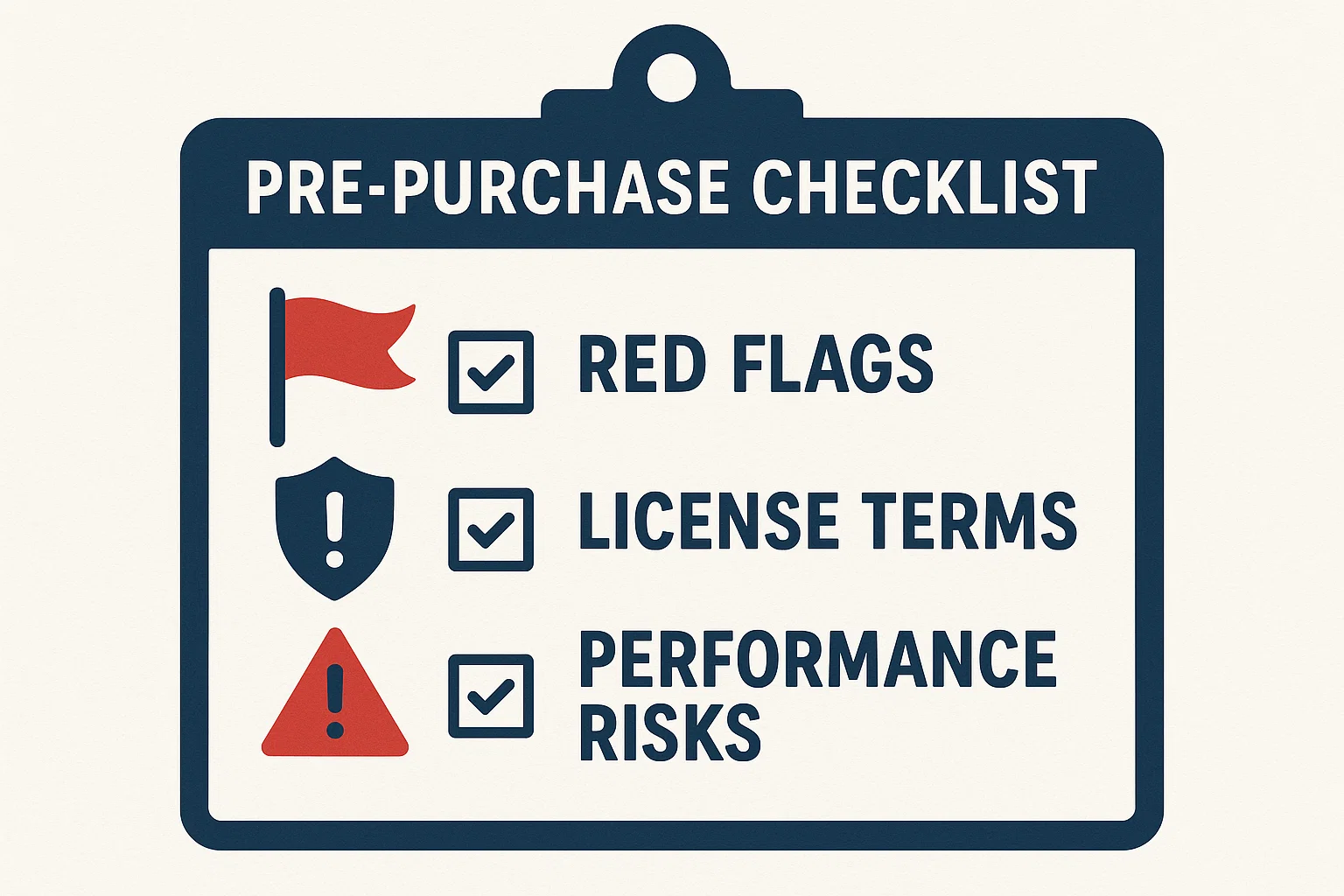
If you buy the wrong FiveM script, you won’t just waste money—you’ll inherit downtime, chargebacks, FPS complaints, and a support burden. Use this page as your pre-purchase gate: audit the vendor, decode the license, predict performance, and compare refund/update terms before you spend a cent.
Related reading (open in new tabs):
- How to Evaluate, Test, and Maintain FiveM Scripts — pillar process for sandboxing, CI, and long-term upkeep: https://fivemx.com/maintain-fivem-scripts/
- FiveM Asset Escrow: Limits, Myths, and Workarounds — what you can/can’t do when code is locked: the pre-purchase checklist
TL;DR — Quick Pre-Purchase Checklist
Vendor & Reputation
- Legal entity listed (name, country, registration or VAT).
- Active support (Discord/ticket/email) with response time < 24h.
- Public changelog; last update < 60 days.
- No unresolved scam/leak threads tied to the seller.
License & Policy
- Commercial use and multi-admin use allowed on your server.
- Refund window (≥ 7 days) with objective criteria.
- Update policy (lifetime or clear major/minor rules).
- FiveM Asset Escrow terms documented; performance-critical parts editable.
- No hidden telemetry / remote code execution without signatures.
Performance & Compatibility
- Resmon avg < 0.10 ms, p99 < 0.50 ms under expected load.
- No DB N+1; key queries indexed; timeouts handled.
- Framework support stated (ESX/QBCore/QBOX) and artifact/version range.
- No heavy global event handlers, no tight
while trueloops.
1) Vendor Due Diligence (Red Flags vs. Green Flags)
Green flags
- Registered business, VAT/Tax ID, country visible on storefront.
- Public changelog and issue tracker; frequent small updates > rare big ones.
- Clear product boundaries (compatible frameworks, server build tested).
- Support SLAs: first response <24h, bugfix ETA policy, security patch policy.
Red flags
- New store, no identity, only DMs for support.
- “No refunds ever” + no demo and no test server.
- “Lifetime updates” claim but no changelog or recent commit history.
- Reputation tied to leaks, bans, or mass DMCA disputes.
Open source improves inspectability, but it is not proof of quality. Check maintenance history, permissions, dependencies, test results and the exact files you are allowed to modify.
Vendor Audit Template (copy/paste)
| Field | Value |
|---|---|
| Vendor name | |
| Storefront URL | |
| Discord/Support URL | |
| Legal entity / Reg No. / VAT | |
| Country | |
| Age of store (months) | |
| Average response time | |
| Update cadence (days) | |
| Public changelog URL | |
| Price / Payment methods | |
| Dependencies (ESX/QBCore/etc.) | |
| Server build tested | |
| Refund policy summary | |
| Warranty / SLA | |
| Risk notes |
JSON schema (drop into your tracker):
{
 "vendorName": "",
 "storeUrl": "",
 "support": { "discord": "", "email": "", "slaHours": 24 },
 "legal": { "entity": "", "regNo": "", "taxId": "", "country": "" },
 "reputation": { "disputesOpen": 0, "notes": "" },
 "changelogUrl": "",
 "updateCadenceDays": 30,
 "product": {
 "priceEUR": 0,
 "dependencies": ["ESX", "ox_lib"],
 "artifactTested": ">= 6148",
 "frameworks": ["ESX", "QBCore"]
 },
 "policies": {
 "refund": { "windowDays": 7, "conditions": ["not as described", "critical bug"] },
 "updates": "lifetime",
 "escrow": { "enabled": true, "editableFiles": ["config.lua"] }
 },
 "riskScore": 0,
 "notes": ""
}
2) License Clause Cheat-Sheet (Decode Before You Buy)
| Clause | What good looks like | Red flags |
|---|---|---|
| Scope of Use | Commercial use on buyer-owned servers; unlimited players | “Personal use only,” per-IP lock, vague “non-commercial” |
| Seats/Instances | Per server/org with offline mode if DRM | Per-CPU/machine DRM, breaks on host migration |
| Modifications | Config edits allowed; source edits where escrow isn’t required | “No edits at all; edits void support” |
| Asset Escrow | Clear list of unencrypted files; performance-critical parts editable; fallback path | Everything locked; remote checks; no method to tune performance — see Asset Escrow |
| Updates | Lifetime or versioned policy spelled out (e.g., v1.x free) | “At-will” paid updates; no security patch commitment |
| Refunds | ≥ 7-day window; objective criteria; process documented | Blanket “no refunds,” no demo/test server |
| Telemetry | Opt-in, purposes & data categories listed, toggle in config | Hidden telemetry, device fingerprinting, outbound on start |
| Liability/Warranty | Bug/security warranty period; best-effort SLA | Full disclaimer, terminate anytime, no recourse |
| Termination | Notice + cure period | Immediate termination at sole discretion |
Tip: If escrow is used, confirm which Lua/NUI files remain editable (configs, translations, performance-critical loops) and whether the vendor provides profiling advice. If not, add points to the risk score.
3) Refund & Updates Policy — Comparison Worksheet
What to capture
- Refund window & conditions: objective testability (“not as described”, reproducible critical bug).
- Update policy: lifetime vs. major vs. minor; paid upgrades; security patches not promised.
- Transferability: can you transfer the license if you sell the server?
- Auto-updates: delivery mechanism and rollback plan.
| Vendor | Refund window | Conditions | Request method | Update policy | Paid upgrades? | Security patch policy | Transfers allowed? | Notes |
|---|---|---|---|---|---|---|---|---|
4) Performance Risk Model (Decide Before You Commit)
Acceptance targets
- Server CPU (resmon avg): < 0.10 ms idle & typical use; p99 < 0.50 ms under burst.
- Client FPS delta: baseline vs. with resource ≥ −5 FPS on mid-tier GPU.
- DB discipline: no N+1; indexing on foreign keys; timeouts handled.
- NUI: input→paint < 100 ms; no blocking
fetchloops. - Tick safety: no heavy work on global events; avoid
while true dobusy-waits; use timers.
Evidence to request from vendor
- Short resmon video/screens under scripted scenarios (idle, 8 players doing the core action).
- Explain/Analyze for heaviest queries; show index plan.
- NUI performance capture (DevTools Performance panel).
- Config toggles that lower draw calls or network spam.
5) Security & Compliance (Don’t Import a Backdoor)
Require:
- No remote code execution /
loadstringfrom HTTP without signature verification. - No hidden analytics or device fingerprinting (opt-in only, clear data categories).
- Clear handling for keys/activation in offline mode.
- No credential collection; no Discord token harvesting; no “anti-leak” that acts like malware.
Red flags: binary blobs with network calls, obfuscated HTTP endpoints, “phone-home” on start, or “anti-leak” that bans staff/admin IPs.
6) Price & ROI (Total Cost of Ownership)
TCO formula (rough):TCO = Price + (Paid updates over 12 months) + (Dependency licenses) + (Staff time to integrate & tune) + (Expected downtime cost)
If TCO > alternative’s TCO by 30% with equal features/perf, don’t buy.
7) Decision Framework (Pass/Fail + Risk Score)
Hard fails (auto-reject)
- No refund window and no demo/test server.
- Hidden telemetry or remote code without signatures.
- Last update > 6 months ago for mission-critical resources.
Risk score (0–100, lower is better)
Score each axis 0–20, sum:
- Vendor & Reputation
- License & Policies
- Performance & DB discipline
- Security posture
- Compatibility & Maintenance
Go/No-Go rule: Only buy if score ≤ 40 and no hard fails.
8) Print-Ready Checklists & Worksheets
You can work directly from the tables above, or download the structured workbook (multiple sheets: Checklist, Vendor Audit, License Clauses, Refund_Updates, Performance Risks):
Use it to compare vendors side-by-side and keep evidence links (screenshots, test clips).
9) How to Validate Claims After Purchase
- Follow the end-to-end testing flow in How to Evaluate, Test, and Maintain FiveM Scripts — spin up a Test City sandbox, capture baseline vs. resource metrics, and keep a changelog.
- If escrow blocks reasonable tuning, revisit your risk score and see FiveM Asset Escrow for safe workarounds.
Appendix A — Copy/Paste “Pre-Purchase Checklist” (compact)
- [ ] Vendor identity verified (legal name, country, VAT/reg no.)
- [ ] Active support & SLA (<24h first response)
- [ ] Public changelog; last update <60 days
- [ ] Clear frameworks & artifact versions supported
- [ ] License: commercial use allowed; instances clarified
- [ ] License: modifications allowed (config + perf-critical areas)
- [ ] Asset Escrow terms documented (editable files listed)
- [ ] Refund window ≥7 days with objective criteria
- [ ] Update policy defined (lifetime/major/minor), security patches not promised
- [ ] No hidden telemetry; no remote code without signatures
- [ ] Resmon avg <0.10 ms; p99 <0.50 ms
- [ ] No DB N+1; indexes on FKs; timeouts handled
- [ ] NUI input→paint <100 ms; no blocking loops
- [ ] No heavy global handlers; no hot `while true` loops
- [ ] TCO within 30% of best alternative
Appendix B — License Clause Review (fill-in)
| Clause | OK? | Notes |
| --- | --- | --- |
| Commercial use allowed | | |
| Seats/instances clear | | |
| Modifications allowed | | |
| Asset Escrow scope clear | | |
| Refund window & process | | |
| Update policy & security patches | | |
| Telemetry opt-in only | | |
| Liability/Warranty stated | | |
| Termination with cure period | | |
Ship it: Run the checklist, assign the risk score, and only proceed if it passes. If anything feels hand-wavy, it’s a no.
Bonus: Trusted Tebex Shops
Verify the exact FiveMX listing before checkout
When comparing a resource on FiveMX, use FiveMX Marketplace Evidence to see which catalog facts are public, partially verified or not claimed across the marketplace. Review the exact listing in the FiveM scripts marketplace, then check the current Terms and Conditions and Refund Policy.
If a framework, dependency, included-file or order detail is unclear, ask through FiveMX Support before installing the resource on a live server.