Video Preview of this HUD
https://streamable.com/9xv48b
https://streamable.com/5mkf0n
Argus HUD - Modern Customizable Status Display for ESX & QBCore
Argus HUD transforms your FiveM server's user interface with a sleek, modern heads-up display that presents crucial player information in an elegant and unobtrusive format. Unlike cluttered legacy HUDs that dominate screen real estate, Argus uses a minimalist design philosophy that shows players exactly what they need to know - health, armor, hunger, thirst, stamina, oxygen, and vehicle status - without blocking their view or creating visual noise. The clean circular status indicators and smooth animations create a professional polish that immediately elevates your server's perceived quality.
What sets Argus apart from dozens of other HUD scripts is its extensive customization system that lets server owners tailor every aspect of the interface to match their server's aesthetic. Change colors, adjust icon positions, modify status bar styles, toggle individual elements on or off, and control when certain indicators appear. Whether you're running a serious military roleplay requiring tactical displays or a casual city server wanting something modern and friendly, Argus adapts to your vision while maintaining excellent performance across all hardware configurations.
What's Included
The Argus HUD package provides a complete interface replacement covering all essential player status elements. You'll get customizable health and armor displays with smooth depletion animations, hunger and thirst meters that integrate with your metabolism systems, stamina tracking for sprinting and physical activities, oxygen levels for underwater exploration, a modern speedometer with gear indicators for vehicles, compass and street name displays for navigation, voice chat indicators showing who's speaking in proximity, and weapon/ammo counters during combat situations.
Each component is individually configurable, allowing you to enable only the features your server needs. Running a hardcore survival server? Emphasize hunger, thirst, and stamina displays. Operating an arcade-style racing server? Focus on the speedometer and minimize survival elements. The modular architecture means you're never stuck with interface elements you don't want cluttering the screen.
Key Features
- Circular Status Indicators - Modern radial progress displays for health, armor, hunger, thirst with smooth fill animations
- Dynamic Vehicle HUD - Speedometer, fuel gauge, gear indicator, and engine health that appears only when driving
- Customizable Positioning - Drag-and-drop editor lets you place each HUD element exactly where you want on screen
- Color Customization - Full RGB color picker for every UI element to match your server's branding and theme
- Conditional Display Logic - Status bars can hide when full, appear only when relevant, or stay persistent based on preferences
- Voice Indicator Integration - Visual indicators show who's talking in proximity, radio, or phone calls with TokoVOIP/Mumble/PMA support
- Cinematic Mode - Toggle HUD visibility completely for screenshots, videos, or immersive roleplay moments
- Performance Optimized - Runs at 0.00-0.01ms idle, 0.02ms when actively updating, negligible FPS impact
- Multi-Language Support - Built-in locale system supports English, Spanish, French, German, and custom translations
- Framework Agnostic - Works with ESX, QBCore, QBOX, and can be adapted for standalone/custom frameworks
- Mobile Responsive Design - Automatically adjusts layout for different aspect ratios and screen resolutions
- Animation Configurability - Adjust transition speeds, fade timing, and update intervals to match your server's feel
Perfect For
- Servers wanting a modern, professional interface that matches current gaming UI trends
- Communities where immersion matters and cluttered HUDs break the roleplay atmosphere
- Server owners who value customization and brand consistency across all visual elements
- Performance-conscious servers needing efficient UI solutions that don't tank frame rates
- Roleplay servers requiring clear status information without arcade-style visual pollution
- Servers upgrading from outdated default HUDs to contemporary interface design
Installation & Setup
- Extract the Argus HUD resource to your server's resources folder
- Ensure your framework (ESX or QBCore) is properly installed and functioning
- Configure which status elements to display in the config.lua file
- Customize colors, positions, and display thresholds to match your preferences
- Add the resource to your server.cfg ensuring it loads after your framework
- Restart your server and join to access the HUD configuration menu (/hud or configurable command)
- Use the in-game editor to fine-tune positions and test visibility during various activities
- Export your configuration to apply server-wide or let players customize individually
Framework Compatibility
- ✅ ESX Legacy - Full integration with ESX status system, job displays, and society features
- ✅ QBCore - Native QBCore support with stress system, needs system, and vehicle integration
- ✅ QBOX - Compatible with QBOX framework with all modern features enabled
- ✅ Standalone - Can operate independently with basic health/armor/vehicle stats
Customization Deep Dive
Argus HUD's configuration system provides granular control over every visual aspect. The color picker supports full RGB values plus transparency control, letting you match your server's brand colors perfectly. Want your health bar to be red when critical, orange when damaged, and green when full? Configure threshold-based color changes. Prefer minimalist monochrome? Set everything to white with varying opacity levels.
Positioning isn't limited to presets - the visual editor lets you drag elements anywhere on screen with pixel-perfect precision. Some servers place all status indicators in the bottom-left corner for consolidated information. Others spread them across the screen edges for peripheral awareness. Driving-focused servers might enlarge the speedometer and move it front-and-center while minimizing survival stats.
Display logic configurations control when elements appear. Set health bars to hide when above 80% to reduce clutter, only showing when players take damage. Configure hunger/thirst to pulse when critical rather than displaying constantly. Make the oxygen meter appear only when underwater, disappearing immediately upon surfacing. These conditional displays keep the screen clean while ensuring critical information is never missed.
Vehicle HUD Components
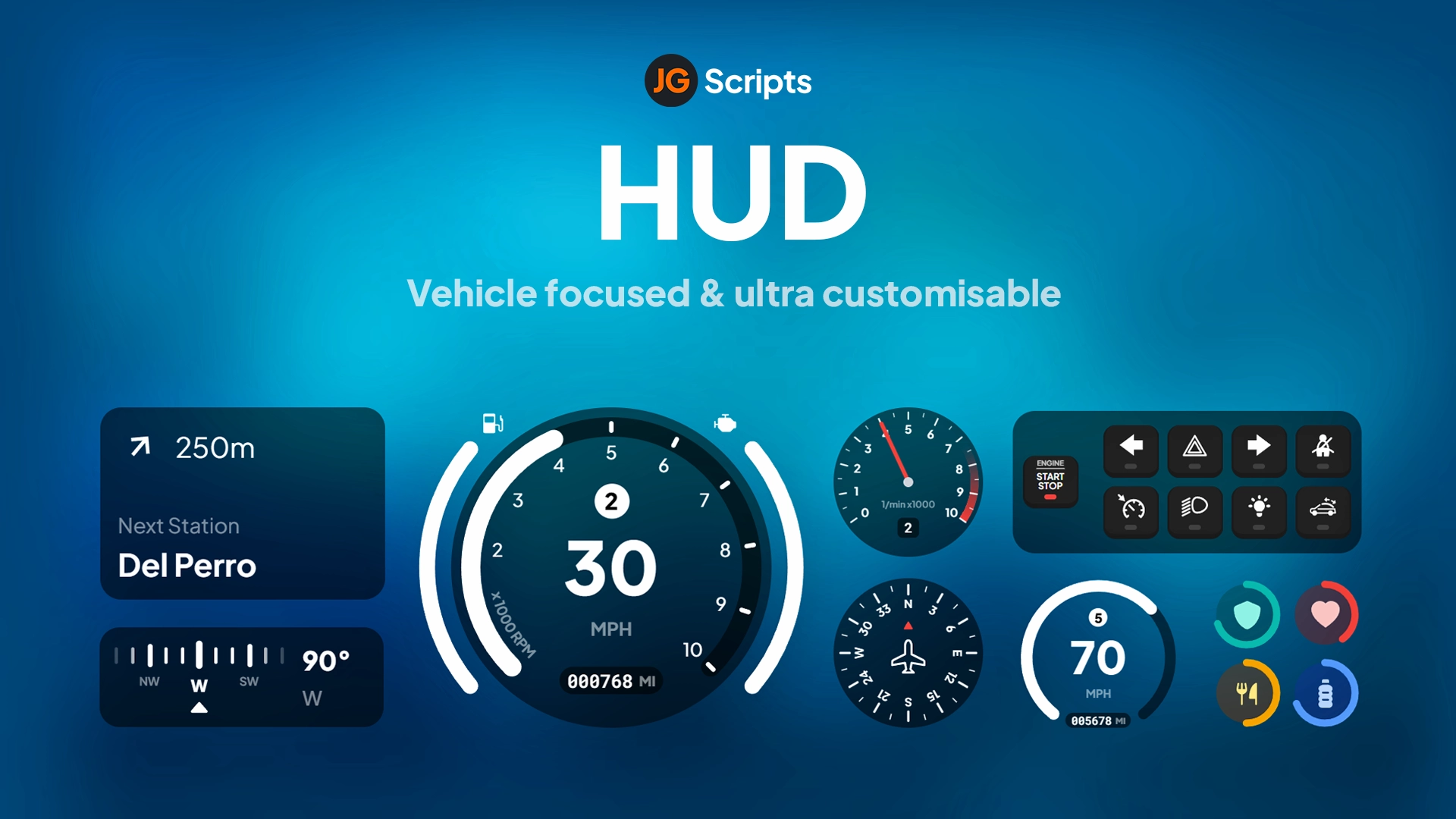
The vehicle interface deserves special mention for its thoughtful design. When players enter a vehicle, a sleek speedometer appears showing current speed in MPH or KPH (configurable), current gear for manual transmissions, fuel level with low-fuel warnings, engine health that decreases during collisions, and optional indicators for seatbelt status, cruise control, and turn signals if your server uses those systems.
The speedometer design is particularly clean - a semi-circular arc with the speed displayed prominently in the center, gear indication positioned logically, and fuel gauge integrated naturally without feeling tacked-on. The entire vehicle HUD fades in smoothly when entering a vehicle and fades out when exiting, avoiding jarring instant appearance/disappearance that breaks immersion.
Advanced vehicle features include damage indicators showing which parts are failing (engine, transmission, body) with visual warnings that intensify as damage increases. Speedometer needle animations use realistic physics for smooth movement rather than rigid digital jumps. Fuel consumption displays can show estimated range based on current tank levels and driving style.
Performance & Optimization
Despite its visual polish, Argus HUD is remarkably efficient. The script uses modern React-like principles to only update UI elements when values actually change rather than refreshing every frame. Health at 100% that isn't changing? Zero processing cost. The status update system batches multiple value checks into single operations, minimizing client-server communication overhead.
Resource usage typically sits at 0.00-0.01ms when idle (no status changes occurring) and peaks at 0.02ms during active combat or driving when multiple values are updating simultaneously. Even players on lower-end hardware report zero perceivable FPS impact compared to their previous HUD solutions. The efficient code architecture means Argus can run alongside other UI enhancements like phone systems, inventory interfaces, and interaction menus without performance degradation.
Voice Integration
Argus includes robust voice chat indicator systems compatible with TokoVOIP, Mumble-VOIP, and PMA-Voice. When players speak in proximity chat, a subtle indicator appears showing their name and voice range (whisper, normal, shout). Radio communications display differently with channel information, helping players distinguish between proximity talk and radio chatter. Phone calls get their own indicator style, creating visual clarity in complex communication scenarios.
The voice indicators support the talking animations and lip-sync systems, coordinating visual feedback across multiple interface elements. Server owners can customize indicator colors per communication type - green for proximity, blue for radio, yellow for phone - creating instant visual recognition without requiring players to read text labels.
What Makes It Stand Out
Many HUD scripts look modern in screenshots but feel clunky in actual gameplay due to poor animation timing, excessive visual noise, or inconsistent design language. Argus maintains coherent design principles throughout - the same circular motif used for health bars appears in stamina displays, the color scheme remains consistent across all elements, and animation timings create a unified rhythm rather than each component feeling like it came from different scripts.
The attention to detail extends to edge cases most developers ignore. What happens to the HUD when players open inventory? It intelligently shifts to avoid overlap. During full-screen cutscenes or camera shifts? It fades out automatically. When players are spectating after death? Status bars display the spectated player's information rather than the dead player's empty values. These polish details separate professional UI systems from amateur attempts.
Player Customization Options
Beyond server-level configuration, Argus can allow individual player customization if desired. Each player can access a configuration menu to adjust HUD opacity, choose between metric/imperial units for speed and distance, toggle individual elements on/off, select color themes from presets, and save their personal layout. These preferences persist across sessions, creating personalized experiences while maintaining the server's overall design standards.
For servers preferring uniformity, player customization can be disabled entirely, enforcing the server-configured layout on all players. This ensures consistent screenshots, videos, and streaming content where the HUD always looks identical regardless of who's playing.
Technical Specifications
- Performance: 0.00-0.01ms idle, 0.02ms peak during active updates
- Framework: ESX, QBCore, QBOX, Standalone
- Client-Side Only: No server resources consumed (pure client rendering)
- Voice Compatibility: TokoVOIP, Mumble-VOIP, PMA-Voice, SaltyChat
- Resolution Support: 1280x720 minimum, optimized for 1920x1080, supports ultrawide/4K
- Language Support: 12+ languages included, custom locale support
- Update Frequency: Configurable (default 200ms for status, 50ms for vehicle)
- File Size: ~5 MB (including all assets and configurations)
Integration with Existing Systems
Argus HUD plays well with other popular scripts rather than fighting for screen space. It automatically detects and adjusts positioning around inventory systems like qb-inventory, ox_inventory, or custom solutions. Phone scripts like GCPhone, YSERIES, or QB-Phone trigger HUD elements to shift out of the way. Progress bar systems, interaction prompts, and notification displays are detected and avoided through intelligent spatial awareness.
The script exports functions allowing other resources to programmatically hide/show specific HUD elements during special activities. A racing script might hide everything except the speedometer during events. A heist script could hide all HUD during planning cutscenes for cinematic presentation. These integration points make Argus a team player in your script ecosystem rather than a rigid component that conflicts with everything else.
Support & Documentation
Your purchase includes comprehensive documentation covering installation, configuration options, troubleshooting common issues, and integration guides for popular frameworks and voice systems. The config file contains detailed comments explaining every setting with examples. Video tutorials demonstrate the visual editor and customization process for server owners unfamiliar with UI scripting.
Argus receives regular updates maintaining compatibility with FiveM updates and framework changes. The developer actively addresses bug reports and considers feature requests from the community. All updates are provided free to existing customers, ensuring your HUD investment remains current as FiveM and your server evolve.